

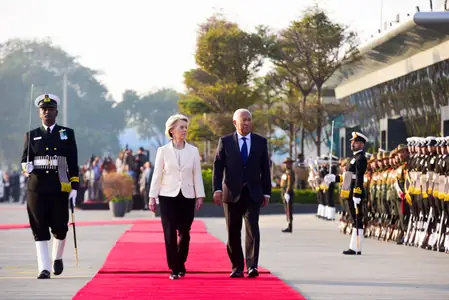
Sunday’s skies over New Delhi welcomed Europe’s power duo—Antonio Costa of the European Council and Ursula von der Leyen of the Commission—with open arms and a resounding Guard of Honour. As chief guests for India’s 77th Republic Day, their visit heralds intensified India-EU collaboration via the upcoming 16th summit.
Jitin Prasada, holding portfolios in commerce, industry, and IT, escorted Costa from the tarmac. Foreign Ministry’s Randhir Jaiswal tweeted the formalities, stressing deepened strategic bonds. Costa reciprocated on X: ‘Privileged to arrive in New Delhi for the EU-India Summit ahead of the 77th Republic Day. Cheers to our expanding links in commerce, defence, eco-transitions, and cultural exchanges.’
Von der Leyen touched down Saturday, seamlessly integrating into the schedule culminating in PM Modi’s summit on the 27th. Costa noted beforehand: ‘India stands as the EU’s vital ally in maintaining a rule-governed world.’
Expectations run high for breakthroughs in trade liberalization, tech standards harmonization, and climate finance. The EU’s push for diversified partnerships post-Ukraine war finds a willing partner in India’s self-reliant ethos.
Republic Day itself promises a feast for the senses: precision drills, aerial ballets, and state floats chronicling India’s journey. Yet, behind the pageantry lies substance—negotiations that could reshape global value chains, from pharmaceuticals to renewables.
This diplomatic crescendo underscores shifting geopolitics. India, balancing East and West, leverages EU ties for tech transfers and market access, while Europe courts India’s demographic dividend and strategic location. Outcomes here could redefine alliances for the decade ahead.