

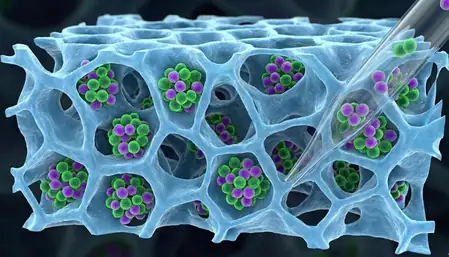
Researchers from IIT Bombay have introduced a cutting-edge protocol using nanofiber scaffolds to efficiently recover T-cells cultivated outside the body, a game-changer for CAR T-cell immunotherapy in cancer care. This addresses a core inefficiency, ensuring higher yields of functional cells for life-saving infusions.
The CAR T-cell pipeline—drawing T-cells from blood, reprogramming them lab-side for tumor specificity, scaling up, and re-administering—relies on flawless cell recovery. Damage during this stage often dooms therapies, as dead or weakened cells fail to deliver.
As Professor Prakriti Tayalia of the Biosciences and Bioengineering Department at IIT Bombay puts it, ‘Theoretical ease belies the practical nightmare of cell recovery. Without ample healthy specimens, research stalls and treatments falter.’
The solution lies in electrosprayed polycaprolactone scaffolds: delicate, net-like fiber arrays that simulate native tissues. Housing Jurkat T-cells—essential for studying T-cell dynamics in cancer and HIV—these scaffolds enabled deep cell integration, vividly observed via microscopy.
Harsh trypsin digestion ravaged cell populations. In a smart pivot, Accutase extraction preserved life and function: cells clustered for proliferation, grew vigorously post-retrieval, behaving indistinguishably from pristine counterparts.
This elegant fix amplifies therapy reliability, cuts losses, and scales production—key to democratizing CAR T-cells. With cancer’s global toll mounting, IIT Bombay’s contribution heralds more potent, patient-centric solutions, blending engineering precision with biological insight for tomorrow’s cures.