


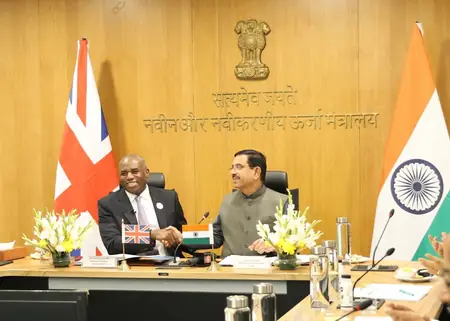
Marking a pivotal step in renewable energy diplomacy, India and the UK inaugurated the Offshore Wind Taskforce amid high-level talks in New Delhi. Pralhad Joshi, India’s renewable energy minister, and David Lammy, UK’s deputy premier, led the launch, joined by High Commissioner Lindy Cameron.
Far from ceremonial, this mechanism—tied to Vision 2035 and the fourth Energy Dialogue—focuses on strategic oversight for India’s offshore wind expansion.
UK’s leadership in vast deployments and supply ecosystems meets India’s demand-driven market and clean energy momentum. Joshi’s ‘Trustforce’ moniker highlights trust-fueled problem-solving.
Three pillars guide efforts: market-ecosystem reforms including seabed and revenue optimizations; supply chain builds with modernized ports, local fabs, and ships; and financial innovations for blended funding and enduring capital.
India’s transition emphasizes stability, with offshore wind central to grid, industry, and security goals. Coastal potentials in Gujarat and Tamil Nadu are mapped via NIWE, supported by Rs 7,453 crore (~£710M) gap funding. Challenges like ports, sea logistics, and regimes are squarely addressed.
Synergy with green hydrogen shines: India’s mission yields Rs 279/kg H2 and Rs 49.75/kg ammonia at bid lows, spearheading global breakthroughs. Wind power feeds coastal industries, enhancing resilience.
Non-fossil capacity hits 272+ GW (141 GW solar, 55 GW wind), plus 35 GW solar and 4.61 GW wind added yearly. With metrics-driven action, offshore wind cements India’s self-sufficient green future via this landmark partnership.