


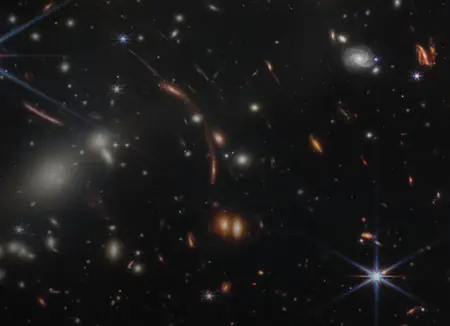
Imagine a universe not merely expanding, but sprinting away from itself—thanks to dark energy, the elusive 70% majority of cosmic contents. NASA’s verdict: this anti-gravity phenomenon is accelerating everything, turning the heavens into a runaway expansion.
It all traces to the Big Bang’s fury 13.8 billion years past, unleashing matter from singularity. Expansion ensued, matter clumping into cosmic web. Prevailing wisdom held gravity would rein it in, fostering collapse or stasis.
Late 1990s supernova studies upended that. Type Ia events, with standard shine, lit the path via Hubble. Unexpected faintness meant greater distances, faster recession—proof of acceleration. Dark energy earned its name as the unknown driver.
Its modus operandi? Repulsive pressure opposing gravitational collapse, intensifying as density drops. Big Bang era favored attraction; today’s sparse cosmos bows to repulsion. Theories abound: constant lambda, quintessence fields, or gravity tweaks.
Hubble and James Webb lead the charge, mapping expansion history. Findings could predict end times—heat death or rip. Dark energy embodies the universe’s wild card, compelling astronomers to confront the unknown with fervor, as each observation peels back veils of mystery.