


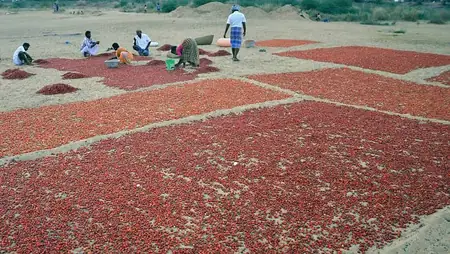
Farmers in Ramanathapuram, Tamil Nadu, are staring at record chili prices exceeding 20,000 rupees per quintal for premium Mundu and Samba varieties, fueled by catastrophic yield drops from pests and drought.
The area’s horticulture mainstay saw sowing on only 13,500 hectares this year, a decline from 15,050, scarred by last season’s fungal epidemics. Low arrivals during peak harvest have inflated market rates dramatically.
Local exporter M. Ramar observes Mundu chilies surging to 25,000-36,000 rupees per quintal—well above the 13,000-20,000 norm—and Samba hitting 20,000-25,000 from 12,000-15,000. In controlled markets, prices are 360 rupees/kg for Mundu and 220 for Samba, almost twice usual.
Over 2,500 hectares fell to pest attacks, worsened by water scarcity. ‘Farmers with borewells or tanker money survived; others didn’t,’ notes grower Ayyappan.
Amid the price euphoria lies deep concern: officials and farmers demand Tamil Nadu government drought relief, enhanced pest defenses, and irrigation boosts to revive production.
This spike could cascade into broader inflation for spices, impacting households and industries. Ramanathapuram’s ordeal serves as a wake-up call for sustainable agriculture in vulnerable regions, blending immediate aid with forward-thinking strategies.