


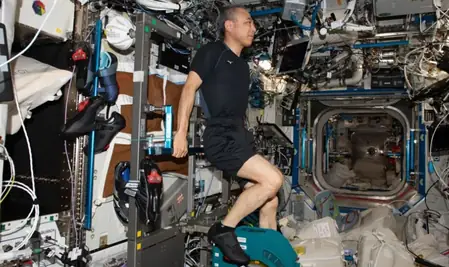
Life in space demands a gym membership like no other. Microgravity erodes astronauts’ bones by 1% each month and atrophies muscles, erasing years of fitness in orbit. Daily terrestrial stresses fortify our frames; zero-G deprives them. ISS crews counter with mandatory two-hour workouts on specialized apparatus, staving off frailty for missions stretching months.
The ARED, debuted 2008, replicates free weights via innovative pistons and flywheels pumping out 600 pounds—perfect for squats, deadlifts, and presses targeting major groups. Bungee-tethered to the T2 Treadmill, they run marathons mid-air, forging resilient legs.
CEVIS, the 2001-originated bike with 2023 enhancements, isolates shakes from the station while logging precise ergometric data. High-intensity paradigms now dominate, backed by research proving efficiency in safeguarding tissues and oxygen capacity over volume-heavy alternatives.
Pre-flight regimens and biopsies confirm molecular safeguards, yet personal physiologies and orbital hurdles—space scarcity, upkeep, climate control—demand adaptive strategies. These disciplined sessions transcend maintenance; they’re the backbone of ambitious endeavors like lunar returns and Martian footholds, embodying peak human adaptation.