


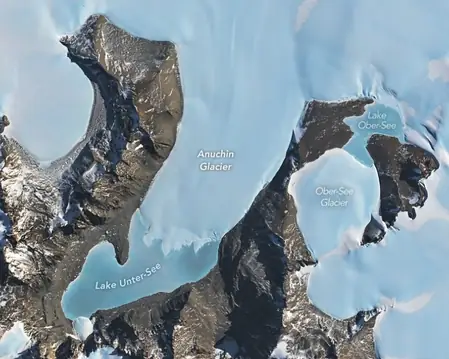
Beneath Antarctica’s relentless ice in Queen Maud Land, Unter-See Lake emerges as a subglacial sanctuary by the Gruber Mountains and Anuchin Glacier edge. Perpetual ice cover prevails amid minus 10°C averages, a testament to endurance in polar extremes.
Captured brilliantly by NASA’s OLI on Landsat 9 February 16, 2026, the summer view pierces the ice to reveal contained waters against a glacial backdrop. Anuchin melt dominates replenishment, sunlight teasing warmth below while winds sublimate the surface relentlessly.
Reaching 558 feet, its waters gleam with high oxygen, minimal CO2, and alkaline tilt—fertile ground for monumental stromatolites. Cyanobacteria architects weave sediment into rising, oxygen-liberating carbonate cones in this unique niche.
Dale Andersen’s 2011 SETI expedition unveiled half-meter specimens, eclipsing counterparts in Lake Joyce. Ideal conditions—sub-ice repose, pure hydraulics, scant particulates, filtered photons—propel their grandeur.
Tardigrades anchor the food web, epitomizing resilience. Echoing 3-billion-year-old Earth life, these mirror primordial fossils from Greenland and Australia. They serve as Earthly proxies for Europa’s, Enceladus’s, and Martian icy domains in astrobiological quests.
Sudden floods disrupt poise. 2019’s Ober-See rupture, pouring 17.5 million cubic meters per ICESat-2 and Ottawa studies, remixed pH and CO2, igniting productivity spikes. As glacial outbursts intensify, Unter-See warns of cascading ecological risks in Antarctica’s thawing underbelly.