


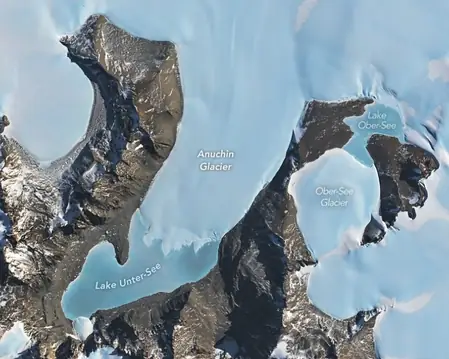
Tucked away in Antarctica’s Queen Maud Land, near the Gruber Mountains and Anuchin Glacier, Unter-See Lake defies the odds as an ice-permanent subglacial gem. Enduring minus 10°C averages, it’s imaged sharply by NASA’s Landsat 9 on February 16, 2026, displaying its frozen expanse and icy backdrop during polar summer.
Primarily replenished by Anuchin meltwaters, subtle solar penetration warms depths slightly, countered by wind-driven evaporation and sublimation that solidify the surface. Reaching 558 feet deep, the lake’s high-oxygen, low-CO2, alkaline profile nurtures microbial marvels.
Conical stromatolites dominate—cyanobacterial masterpieces trapping silt into calcium carbonate spires that grow and oxygenate. SETI geobiologist Dale Andersen’s 2011 discovery unveiled 50 cm giants, eclipsing Lake Joyce’s miniatures, thanks to sheltered, clear, sediment-light, low-illumination environs.
Tardigrades, extremophile champions, are the largest fauna. These edifices glimpse Earth’s 3-billion-year-old biosphere, matching Greenland and Australian fossils. Astrobiologists prize them as analogs for subsurface worlds on Europa, Enceladus, and ancient Mars.
Appearances deceive: 2019 University of Ottawa work and ICESat-2 data confirmed Ober-See’s outburst poured 17.5 million cubic meters into Unter-See, tweaking chemistry and boosting life activity via CO2 and pH changes. Such floods warn of cascading ecological harms in Antarctica, as glacial dynamics intensify.