


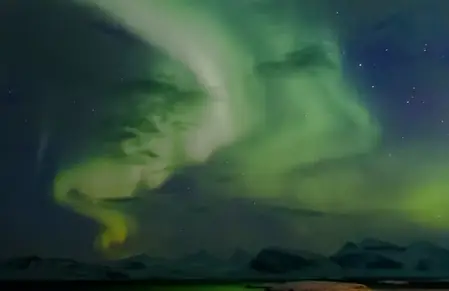
Auroras mesmerize with their fluid dance of greens, purples, pinks, and beyond, turning night skies into vibrant canvases. Northern versions dazzle high latitudes as Borealis; southern as Australis. This comprehensive breakdown unravels their formation, colors, and observation science.
Charged solar emissions—solar wind—carry the spark. Interacting with geomagnetic fields, particles gain acceleration, streaming poleward. Atmospheric entry excites oxygen and nitrogen: green from O at ~150 km, red from O at zenith heights, N2+ bands for blue-purple, and low-altitude N for rosy shades.
Varied intensities arise from solar events. Coronal holes sustain quiet winds; flares provoke storms, dispersing ovals and boosting brightness. Rare ‘SAR arcs’ add stable reds during recoveries. Colors merge into crowns, rays, and arcs, choreographed by field-aligned currents.
Detection spans instruments: ASI cameras map morphology, spectrometers dissect spectra, Incoherent Scatter Radars gauge drifts. International efforts forecast via models like OVATION, predicting Kp indices for visibility.
Practically, chasers target dark, clear nights post-geomagnetic alerts. Auroras educate on heliophysics, revealing sun’s influence on habitability. With cycle 25 ascending, prime viewing awaits, merging adventure with astrophysics in nature’s grand theater.