


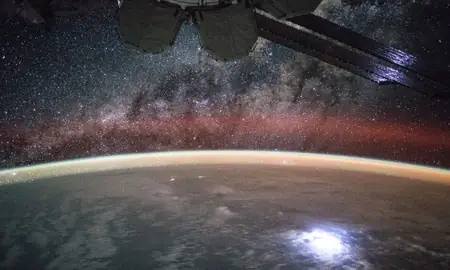
Astronauts aboard the ISS, hurtling 250 miles overhead, capture Earth’s most poetic feature: airglow. This symphony of scarlet, lime, lavender, and gold layers paints the upper atmosphere, a perpetual nightlight born of solar-atomic interactions. It redefines our ‘pale blue dot’ as a beacon of atmospheric vitality.
Delving into NASA’s insights, airglow ignites when diurnal solar radiation excites sparse upper-air molecules. Nighttime relaxation emits photons, echoing auroral mechanics sans solar wind drama—pure, persistent solar fare. Electron-atom encounters sporadically intensify the radiance.
Terrestrially, it underpins sky’s residual luminance, matching stellar output’s decile sans urban glare or moonbeams. Spaceborne, it sheathes Earth in effulgence across ionospheric expanses (50-400 miles), shepherding signals and voyagers alike.
Spectral signatures decode origins: preeminent verdure from oxygen singlets, carmines from nitrogen oxides, occulted bands in non-visual realms. Exospheric tenuousness nurtures excitation longevity, eclipsing lower stratifications’ collisional brevity.
Ever-evolving under heliospheric and barometric cues, airglow proxies ionospheric vicissitudes—trajectories, thermics, consistencies—interweaving cosmical tempests with mundane meteorology for prognostic prowess.
ISS vignettes immortalize these chromatic veils, empowering scrutiny of stratosphere-cosmos nexus. Amid burgeoning orbital congestion, airglow intel fortifies resilience against flares frying electronics or skewing navigations, heralding safer stellar sojourns.