


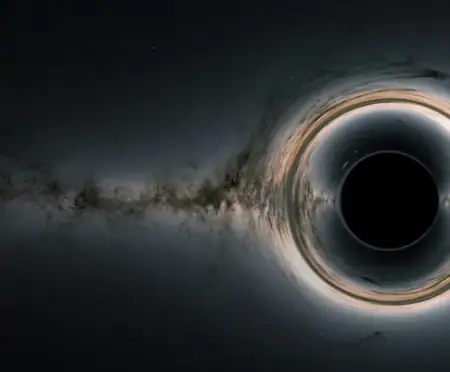
Black holes challenge the limits of physics, embodying gravity’s raw power in regions where density defies logic. Mass compressed to extremes creates gravity wells so profound that photons, the fastest travelers, circle endlessly or plunge inward forever.
Detection hinges on the accretion disk’s spectacle: gas accelerates, collides, and incandesces, spewing X-rays across spectra. This luminous betrayal exposes black holes otherwise cloaked in invisibility.
Gravitational lensing turns them into natural magnifiers. Light from remote sources skirts the event horizon, emerging distorted—enlarged arcs, Einstein rings, or phantom duplicates. Scientists leverage this to spot obscured giants fueling quasar fury.
Central to each is the singularity, shrouded by the event horizon. Sagittarius A*, our galactic anchor, masses 4 million Suns. Tidal doom via spaghettification stretches intruders longitudinally before compression. Extremes define the class: micro at 3.8 solar masses, mega-TON 618 at 660 billion. Spinning variants rotate blisteringly fast, over 1,000 turns per second.
Myths crumble—they form via supernova remnants, exert normal stellar pull remotely, and offer no interdimensional shortcuts. As telescopes advance, black holes yield insights into relativity, quantum realms, and cosmic evolution, remaining the universe’s most profound riddles.