


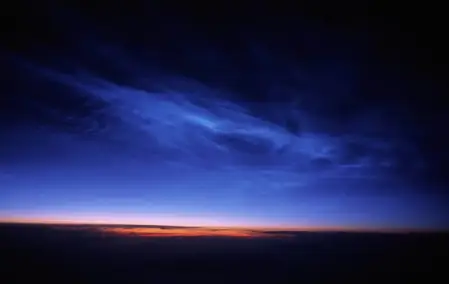
Ever wondered why certain clouds light up the night? Noctilucent clouds, or ‘noctiluca’ in scientific parlance, are the culprits behind these mesmerizing displays. Forming far above commercial flight paths in the mesosphere—50 to 86 kilometers high—they’re made of frozen water vapor nucleated on space dust.
Post-sunset geometry is key: Earth’s shadow engulfs the surface, but the mesosphere stays sunlit, bouncing rays off ice crystals for a luminous effect. Daytime obscures them in glare; nighttime reveals their wavy, filamentary structures in shimmering hues.
NASA’s AIM mission, orbiting since 2007, delivered game-changing insights. Its panoramic scans showed seasonal swathes dominating polar skies, with dynamic changes tracked in real-time. A surprise: uniform ice layers persisting at 82-89 kilometers, fueling ongoing research.
The plot thickens with their recent boldness. Enhanced luminosity and poleward migration tie directly to anthropogenic methane spikes, boosting mesospheric humidity. Over 20 years, this has made them more accessible to mid-latitude observers.
These clouds aren’t just pretty—they’re data points in a larger story of planetary change. Monitoring them sharpens our grasp of ozone, climate forcings, and interstellar influences, urging a deeper look at the skies overhead.