


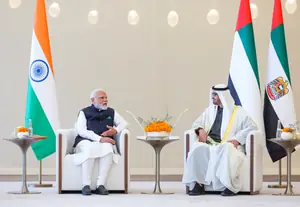
Sunday marked a pivotal moment in India-UAE relations as Prime Minister Narendra Modi held telephonic talks with UAE President Mohamed bin Zayed Al Nahyan, sharply criticizing the attacks on UAE and offering profound solidarity. The exchange emphasized mutual resolve against aggression and commitment to expatriate welfare.
On X, PM Modi noted, ‘Connected with UAE President, my brother Sheikh Mohamed bin Zayed Al Nahyan. Condemned the outrageous attacks, condoled the bereaved, thanked for protecting our Indian brethren, and endorsed de-escalation for lasting peace.’
Rooted in strategic depth, the duo’s ties flourish across commerce exceeding $100 billion, energy pacts, defense dialogues, counter-terror synergy, and NRI empowerment. UAE’s Indian diaspora, a economic powerhouse, cements enduring friendship.
Responding to West Asia’s brewing storm—US-Israel Iran strikes and Khamenei death rumors—PM Modi led a Cabinet Committee on Security session in Delhi. The urgent review assessed implications for India.
Joining were Rajnath Singh, Amit Shah, S. Jaishankar, Nirmala Sitharaman, Ajit Doval, and Vikram Misri. Alighting from state tours around 9:30 PM, Modi prioritized national security imperatives.
As the paramount decision-making forum, CCS steers India through geopolitical tempests, ensuring resilience. Modi’s actions blend diplomatic warmth with security acuity, positioning India as a stabilizing force amid Middle East mayhem.